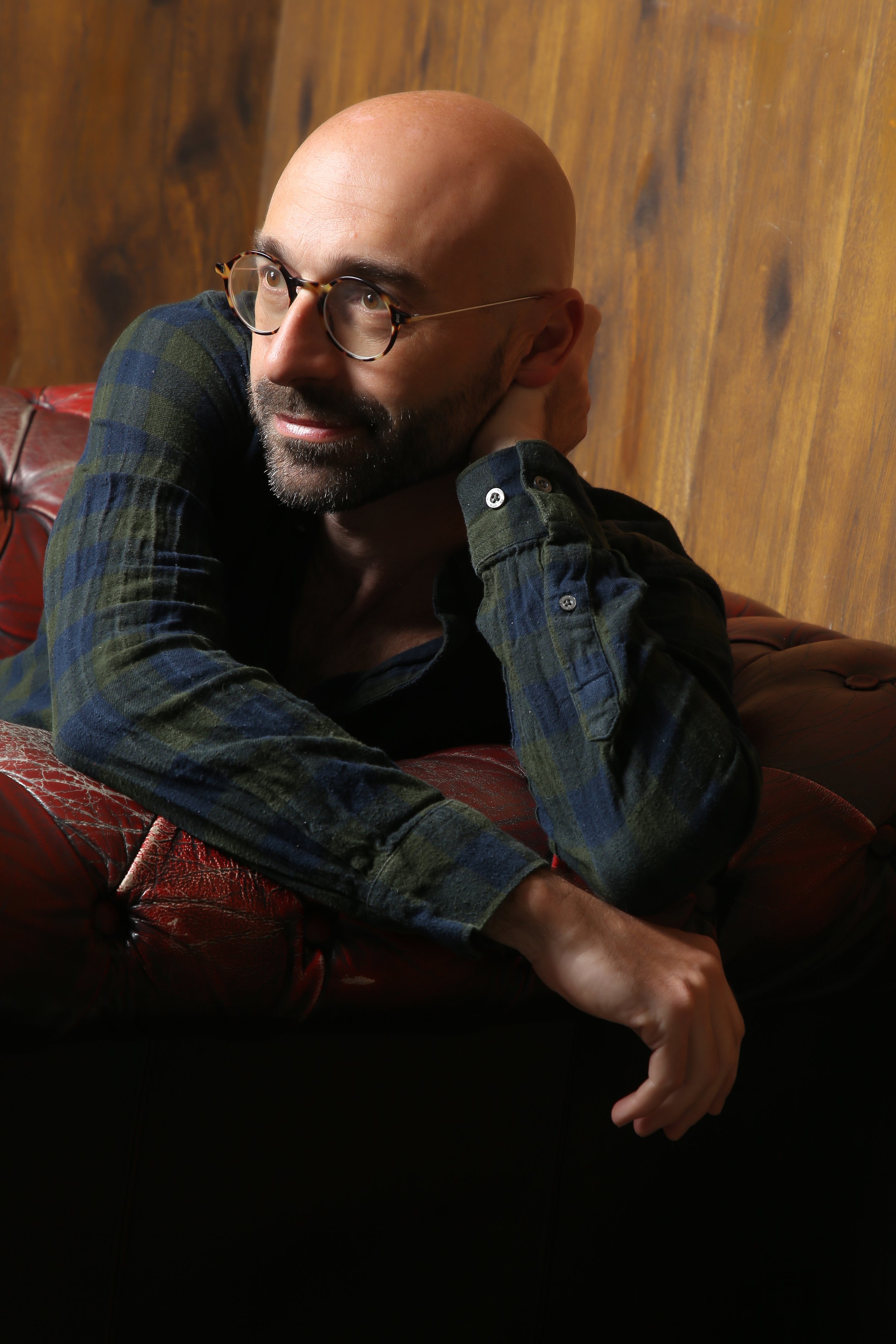
About Carlo
About Carlo
A lifelong question
I’ve spent much of my adult life wondering why something as natural as having a body — and the capacity to experience pleasure — can become so complicated.
Why do so many of us struggle to enjoy ourselves? Why do we find it difficult to slow down, to express desire, to receive, to ask for what we want, or simply to inhabit our own bodies with ease?
For a long time, I thought these were questions about sexuality. Gradually, I realised they were really questions about freedom.
What stops us from living more fully? Which of our ways of thinking, feeling and relating are genuinely ours, and which have simply become so familiar that we no longer notice them? Why do we so rarely question the ideas we’ve inherited about our bodies, our pleasure and our desires?
Those questions have shaped my life for more than twenty years. They led me away from finance and into philosophy, academic research, naturism, embodied practice, and eventually to the work I do today.
Beyond the personal
The more I explored these questions, the more I realised they weren’t simply personal.
The way we experience our bodies, our sexuality and our capacity for pleasure is shaped by culture, education, religion, politics and history. The ideas we inherit about what is acceptable, desirable or shameful are not neutral. They influence how we move, relate, love, work, and even how we imagine ourselves. Many of them were never really our own.
One of the things that continues to fascinate me is how quickly a body simply existing in the world becomes something that needs to be interpreted, judged or justified. Why should being naked require an explanation? Why should pleasure need a purpose? Why do we assume there is a correct, productive or respectable way to inhabit our bodies?
These questions eventually led me to naturism, and later to academic research exploring nudity, shame and freedom in Western culture.
Naturism has never been, for me, simply about being without clothes. It is an opportunity to discover what changes when the body no longer has to hide, perform or justify itself. Not because we uncover some hidden “true self”, but because different ways of relating—and different ways of being—become possible.
I don’t see embodied work as separate from social change. Every moment in which a person relates to their body with greater freedom, curiosity or pleasure gently challenges the assumptions that taught them otherwise. In that sense, this work is both deeply personal and quietly political.
My story
Earlier in my life, I worked in finance. Over time, however, I realised it was no longer the life I wanted to live.
I left banking because I wanted to dedicate myself to the questions that had increasingly come to occupy me: bodies, pleasure, shame, morality, freedom, and the ways we learn to inhabit ourselves. That path led me into philosophy, academic research, naturism, and eventually into embodied practice.
Then life took an unexpected turn.
Following the 2008 financial crisis, I found myself at the centre of one of the UK’s most controversial financial prosecutions. I was convicted and sent to prison. Years later, after a long legal battle, my conviction was overturned by the UK Supreme Court.
Prison didn’t change the questions I was asking. It changed the urgency with which I asked them.
Living under constant surveillance, deprived of privacy and even of the freedom to touch my own body without fear, I experienced first-hand how profoundly our relationship with our bodies can be shaped by systems of control. Questions I had previously explored through philosophy suddenly became intensely personal.
That experience reinforced something I had already begun to understand: reclaiming our bodies, our pleasure and our capacity to experience life more fully is about far more than sexuality. It is about freedom.
(If you’re interested in that chapter of my life, it’s told in Andy Verity’s book Rigged and in the BBC podcast The Lowball Tapes.)
My practice
The questions that first drew me into philosophy and research continue to shape the way I work today.
I don’t see my role as telling people how they should live. I’m much more interested in creating spaces where people can experiment, practise and discover through experience.
We’ll usually begin by talking. But conversation is only the beginning.
Some things can be understood intellectually for years without anything really changing. My work creates opportunities to slow down, practise things you can’t easily practise elsewhere, and gently step outside familiar ways of relating, if only for a while, to see what becomes possible.
Qualifications
My work is informed by both lived experience and formal study.
Professional training
Certified Sexological Bodyworker
Somatic Sexuality Healing Practitioner
Certified Interactive Erotic Educator
Qualified Massage Therapist
Sound Therapist & Gong Practitioner
Training in Tantra and Orgasmic Meditation
Academic qualifications
PhD, Psycho-social Studies (Birkbeck, University of London)
Research focused on nudity, shame and freedom in Western culture.MA, Philosophy (University of California, Riverside)
MA, Psycho-social Studies (Birkbeck, University of London)
A final invitation
If something in these pages has resonated with you, I’d be delighted to hear from you.
Whether you arrive with a clear intention or simply with curiosity, we’ll begin with a conversation and discover together what may become possible.